
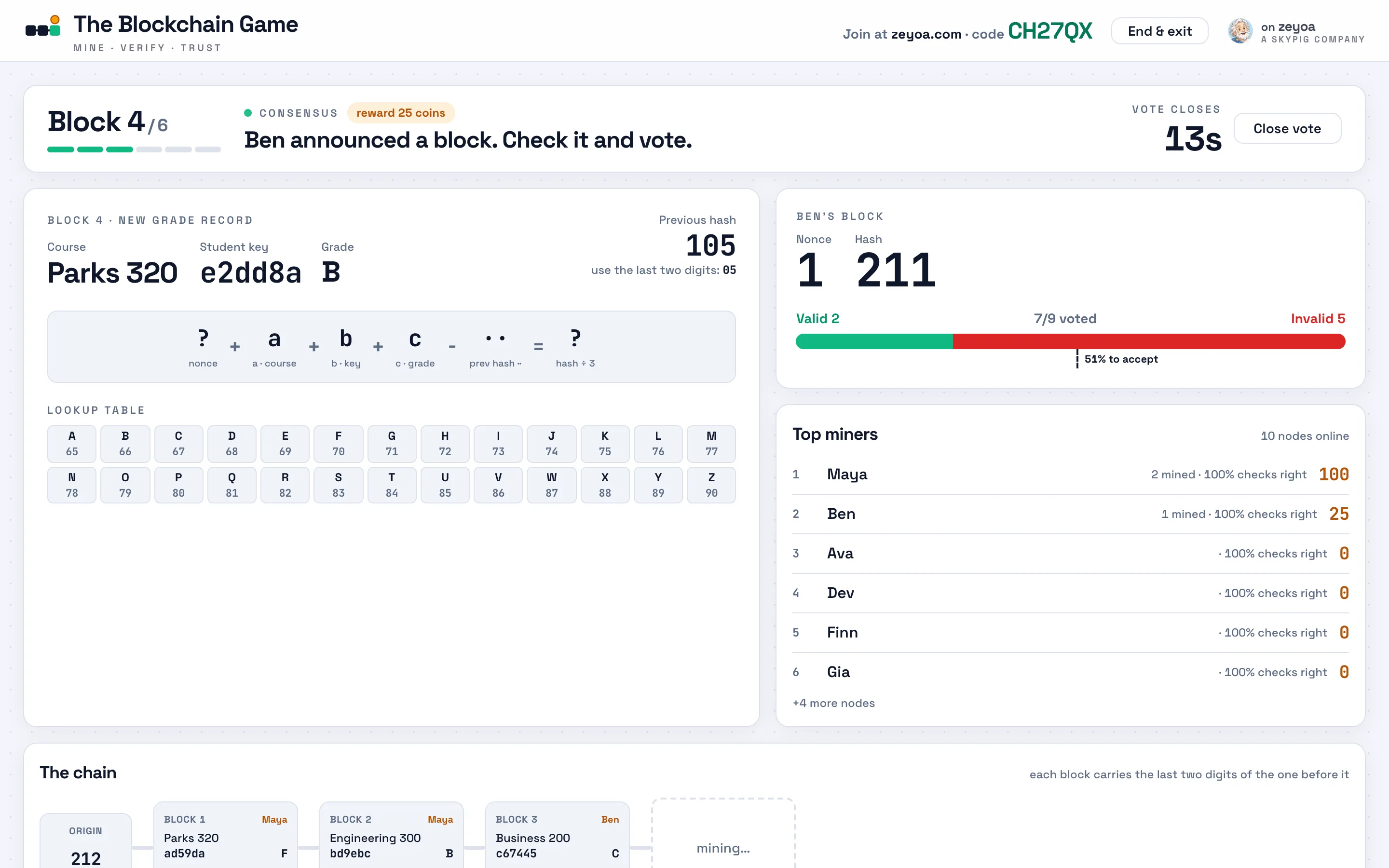
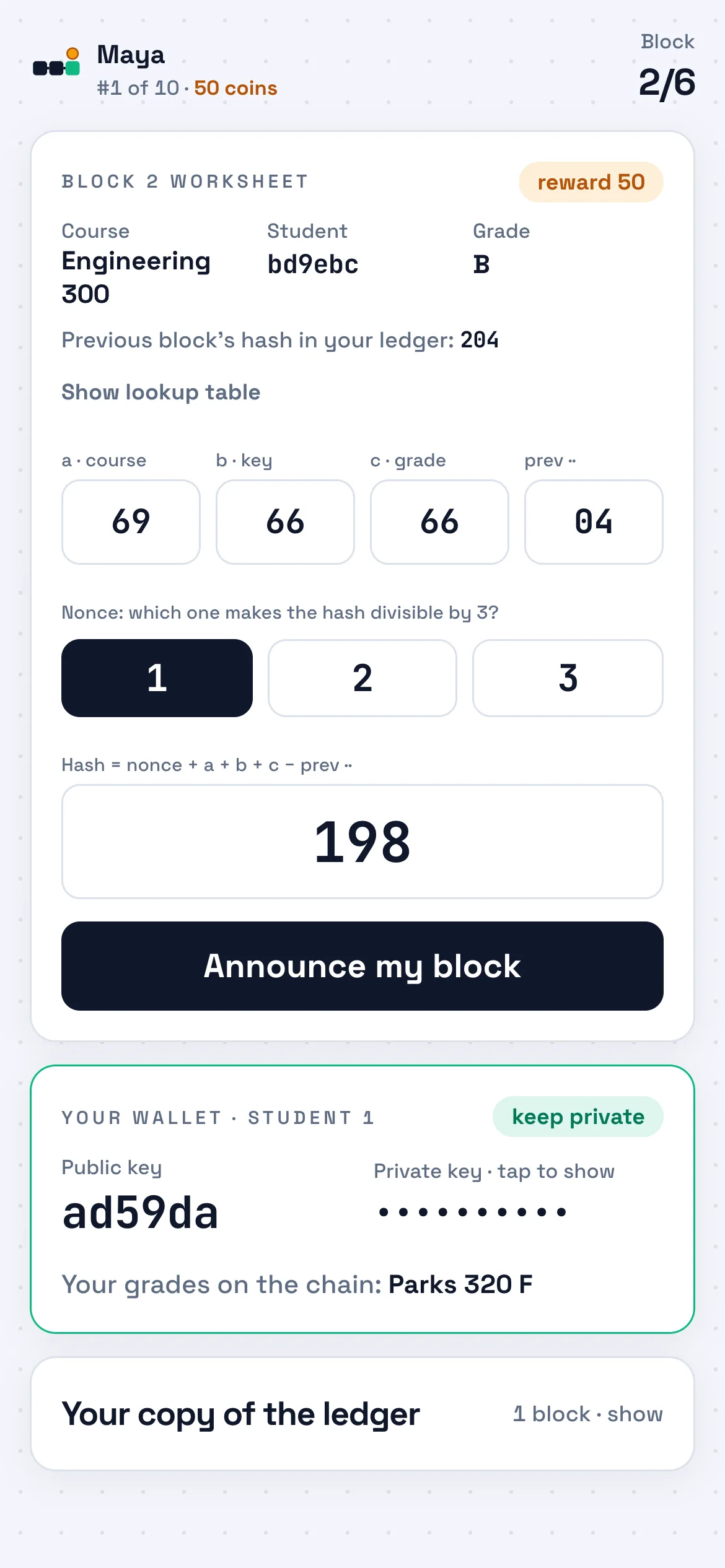
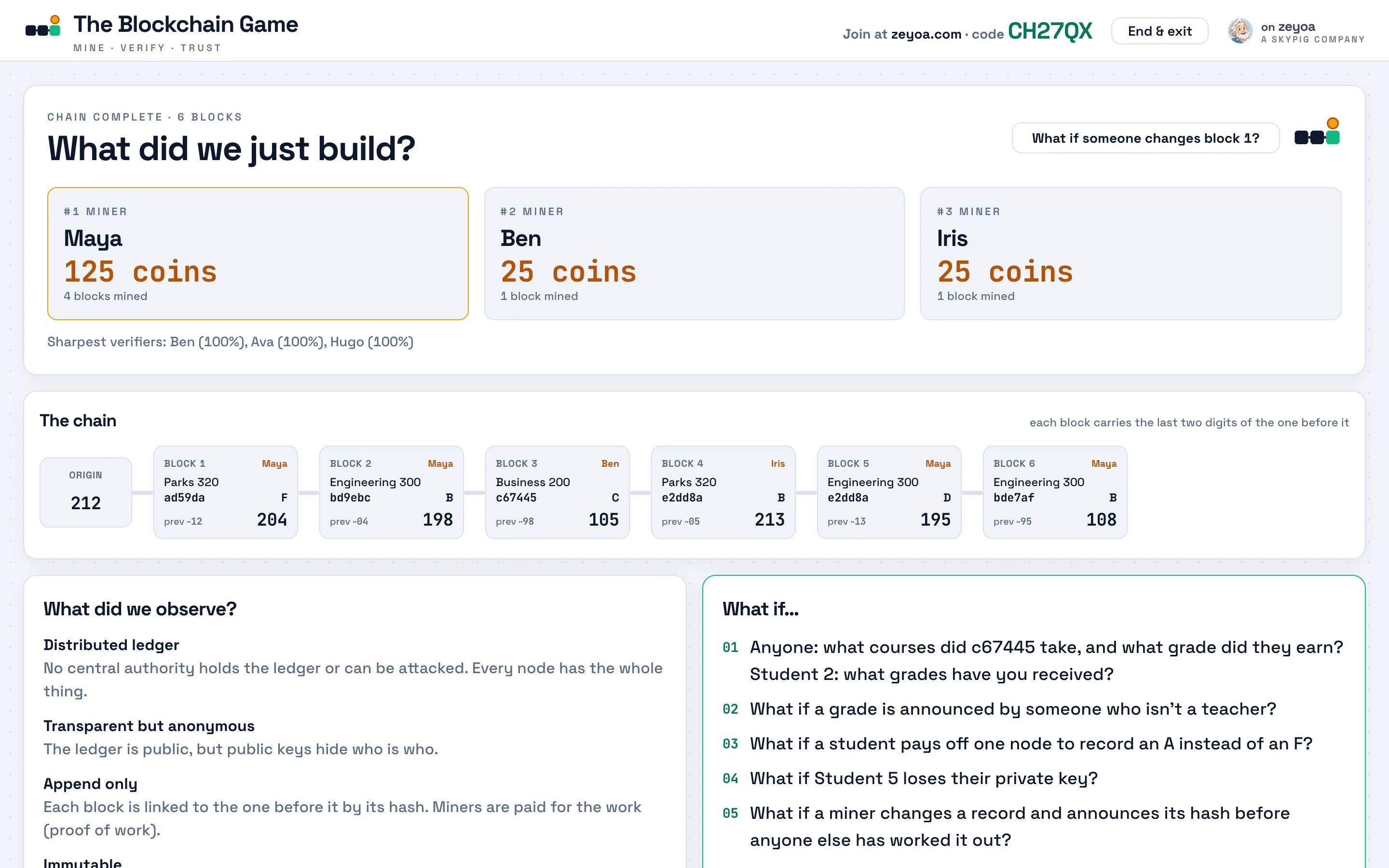
The whole class becomes a blockchain network that records grades. Every student keeps a copy of the ledger, and seven get a wallet with a public and private key. Each block, miners turn the grade record into a hash with a lookup table and simple arithmetic, hunting for the nonce that makes it divisible by 3. The first to announce gets checked by everyone else, and the block joins the chain only with 51% of the votes. Then the teacher tries to bribe the chain and change an old grade, and the class watches every block after it break.
The Blockchain Game was created by J. Scott Christianson (University of Missouri). Adapted for Zeyoa with permission.
Screenshots
What students learn
- ✓What a distributed ledger is, and why no single person can change it
- ✓How a hash links each block to the one before it
- ✓How mining (proof of work) and 51% consensus decide what goes on the chain
- ✓Why public and private keys keep a public ledger anonymous, and when a blockchain is the wrong tool
How it works
- 1The class becomes a blockchain network that records grades. Every student keeps a copy of the ledger.
- 2Seven students get a wallet with a public and private key.
- 3For each block, miners use a lookup table and simple arithmetic to find a nonce that makes the hash divisible by 3.
- 4The first miner to announce is checked by everyone else. The block joins the chain only with 51% of the votes.
- 5Then the teacher tries to bribe the chain and change an old grade, and the class watches every later block break.
A 40-minute lesson plan
Ask: if you wanted to change a grade in the school's computer, who would you need to convince? Then ask: what if every student had a copy?
Play the full game (about 25 minutes). Take your time on the first block so everyone understands hashing.
Ask the class when a blockchain is the right tool, and when a normal database would be better.
Discussion questions
- Why couldn't the teacher change an old grade without anyone noticing?
- What does the 51% vote protect against?
- Why do people use public and private keys instead of names?
- Name something that should go on a blockchain, and something that shouldn't.
Teacher tips
- Needs at least 4 players; 8 or more is recommended.
- Students do the hashing math by hand, so have scratch paper ready.
Questions teachers ask
Who created this game?+
The Blockchain Game was created by J. Scott Christianson (University of Missouri) and is adapted for Zeyoa with his permission.
Do students need to know programming?+
No. The hashing uses a lookup table and simple arithmetic that any middle schooler can do.
More answers in the help center.