
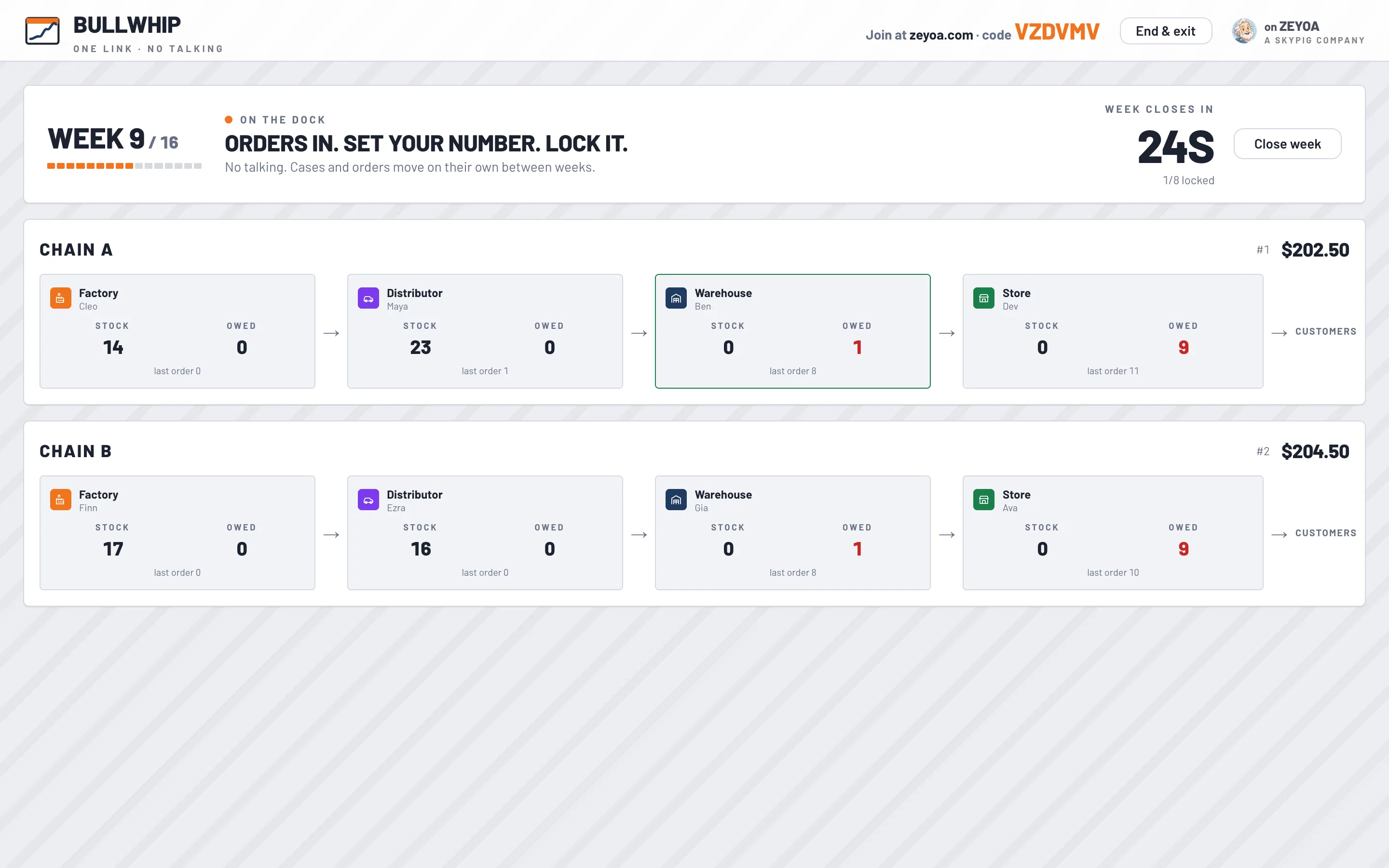
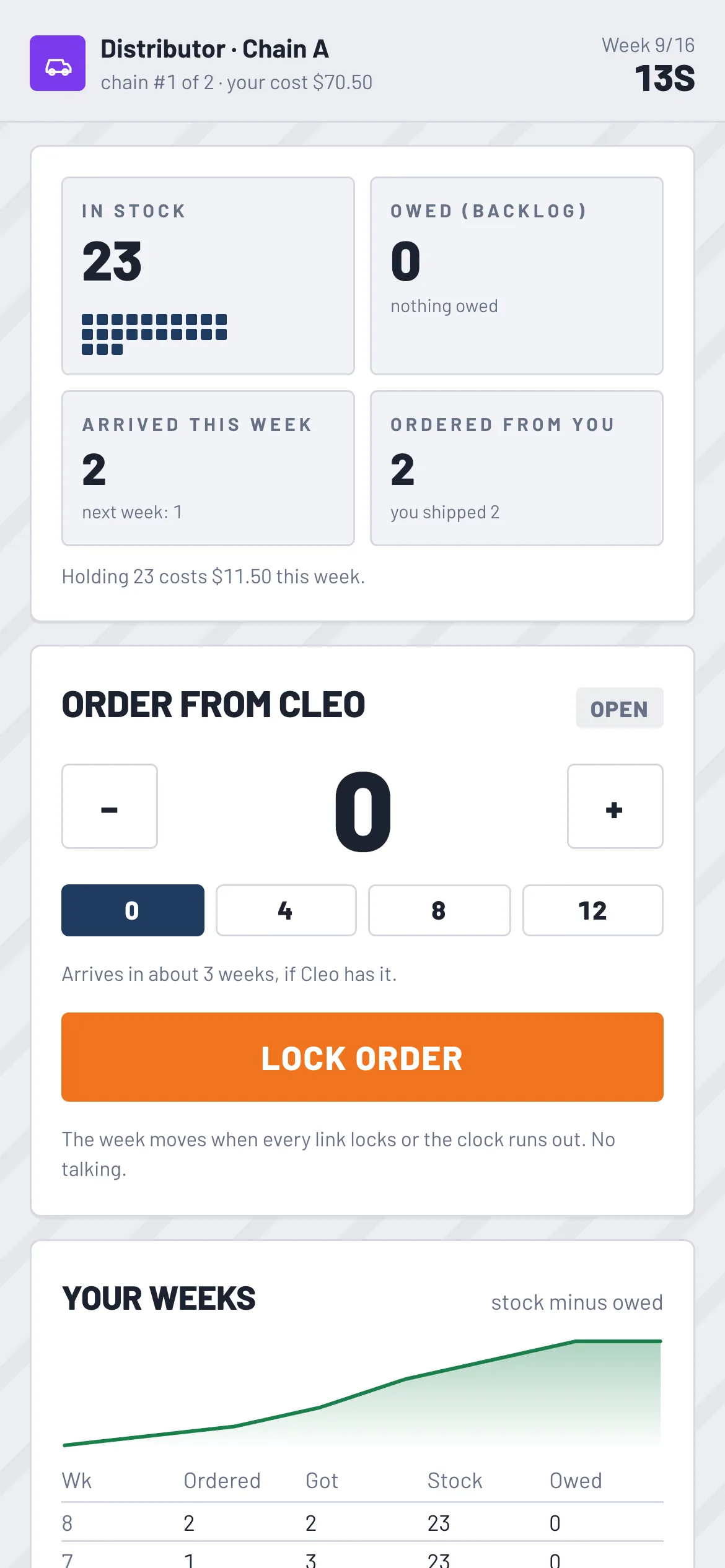
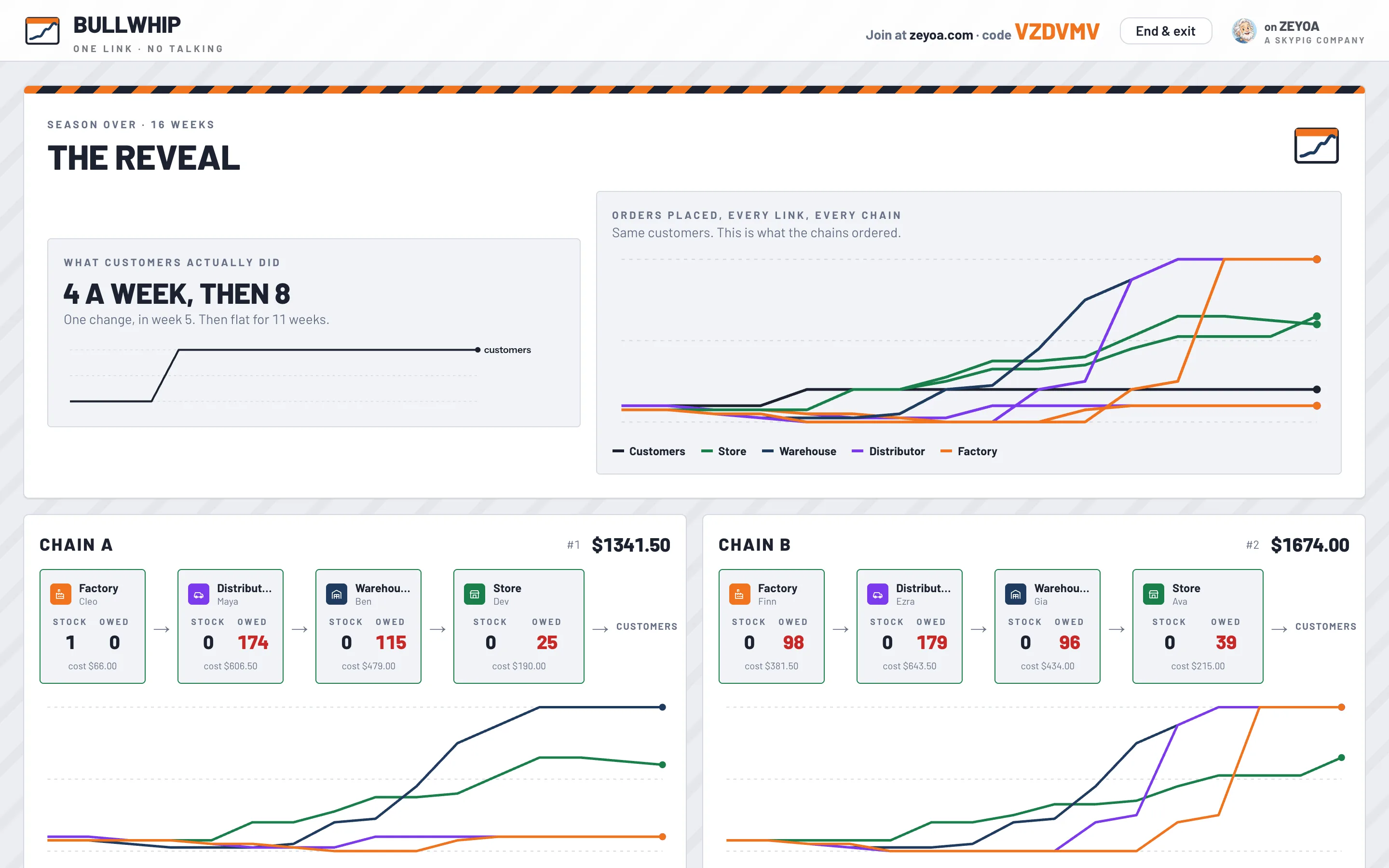
The classic supply-chain game, built for phones. The class is split into chains for a soda brand: Store, Warehouse, Distributor, Factory. Each week every link sees only what the link below ordered and what the link above shipped, sets one number, and locks in. Shipments take two weeks. Stock costs money to hold; unfilled orders cost more. Customer demand changes exactly once all game, and the reveal at the end shows how a small bump at the store became a wild swing at the factory. No talking until then.
Screenshots
What students learn
- ✓Why a small change in customer demand turns into huge swings up the chain (the bullwhip effect)
- ✓What lead time does to a decision: what you order today arrives weeks later
- ✓The two ways inventory costs money: holding it, and not having it
- ✓Why sharing information beats guessing, and what happens when nobody can talk
How it works
- 1The class is split into supply chains of four: Store, Warehouse, Distributor and Factory.
- 2Each week, every student sees only the order from the link below and the shipment from the link above.
- 3They place one order and lock it in. Shipments take two weeks to arrive.
- 4Holding stock costs money. Running out costs more.
- 5Customer demand changes once all game. The final reveal shows how a small bump at the store became a huge swing at the factory.
A 35-minute lesson plan
Explain the one rule: no talking until the game ends.
Play the full game (about 20 minutes) in silence.
Show the reveal and ask the factories to guess what customer demand was. Most guess wildly wrong. Then show the truth: it changed only once.
Discussion questions
- What did you think customers were doing? What were they actually doing?
- Why did small changes at the store become huge swings at the factory?
- What would have happened if everyone could see real customer demand?
- Where have you seen this in real life (toilet paper in 2020, empty shelves, sudden sales)?
Teacher tips
- Needs at least 3 players; 8 or more makes two full chains to compare.
- The silence is the point. Enforce it, then let the room erupt at the reveal.
Questions teachers ask
Is this the same as the MIT beer game?+
It's based on the same classic idea, simplified for a 20-minute class and played on phones instead of a board and paper.
What if the class size doesn't divide by four?+
The game handles it. Every student gets a role in a chain.
More answers in the help center.